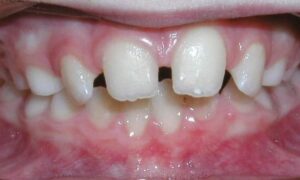
Most orthodontic problems fall into a handful of familiar patterns. Some are about how the teeth are arranged, such as crowding and spacing. Others are about how the upper and lower jaws meet, such as overbites, underbites and crossbites. Most are inherited, and most are far easier to treat when they are caught early.
Here is what the common ones are, in plain language. None of them can be diagnosed from a website, and a few that look alarming turn out to need nothing at all.
Crowding
The most common problem we see. There is not enough room in the jaw for the teeth that have to fit into it, so they overlap, twist or get pushed out of line. Crowding traps plaque where a toothbrush cannot reach, which makes it a dental health issue and not only a cosmetic one. It can also block a tooth from coming through at all.
Spacing
The opposite situation, where there is more room than the teeth need. Gaps can come from small teeth, a missing tooth, or unusually shaped teeth. Spacing between the upper front teeth is the version people notice most.
Overbite
The upper front teeth overlap the lower ones too far vertically. A small amount of overlap is normal and healthy. A deep overbite can wear the lower teeth down over years and, in severe cases, the lower teeth bite into the roof of the mouth.
Underbite
The lower jaw and teeth sit ahead of the upper ones. This is usually skeletal, meaning it comes from the size or position of the jaws rather than the teeth. Often the real issue is an underdeveloped upper jaw rather than an oversized lower one. In a growing child there are more options, so timing matters.
Protruding Upper Front Teeth
The upper front teeth sit noticeably forward of the lower ones. Protruding front teeth are more likely to be chipped in a fall or a collision, which matters if your child plays sports. See custom mouthguards.
Crossbite
One or more upper teeth sit inside the lower teeth instead of outside them. A crossbite at the back often comes from a narrow upper jaw, and children frequently shift the lower jaw sideways to find a comfortable bite. Left alone, that shift can affect how the jaw develops.
Open Bite
The front teeth do not meet even when the back teeth are closed together, leaving a gap you can see. Open bites are often linked to thumb sucking or a tongue habit, and they make biting into food genuinely difficult.
What Happens Next
Every one of these is treatable. The right answer depends on the size of the problem, the patient’s age and how the jaws are growing.
In a child, several of them are easier to correct while growth can still be guided. That is the whole argument for early orthodontic treatment and an orthodontic check by age seven. In teens and adults, most are handled with braces or clear aligners, and a few skeletal cases involve surgical orthodontics.
Reviewed by Dr. Adam J. Veit, DDS, MS, a board-certified orthodontist and the treating doctor at all four Bright Orthodontics offices.
Frequently Asked Questions
Should your front teeth touch when you bite down?
The upper front teeth should overlap the lower ones slightly, not meet edge-to-edge or sit far past them. A small overlap is normal. If the front teeth do not meet at all, that is an open bite and worth having looked at.
Is a small overbite normal?
Yes. Almost everyone has some overbite, and a modest amount is exactly what a healthy bite looks like. It becomes a problem when the overlap is deep enough to wear the lower teeth or reach the palate.
Can crowded teeth be fixed without braces?
Crowded teeth do not resolve on their own, and nothing you can do at home will move them. Mild crowding can sometimes be treated with clear aligners rather than fixed braces. Which option suits your case depends on how much movement is needed.
Can a crossbite be left untreated?
It can, but it rarely improves on its own and it can get harder to correct later, particularly in a growing child. Getting it assessed is worthwhile even if the answer is that we watch it for now.